


DRILLING FOR USE WITH ROAR EXPANSIVE CEMENT

It is important to know how ROARexpansive cement works.Its basic principle is the high pressure it exerts on the material. This expansion pressure must be well directed.The expansion pressure will be directed towards where it encounters the least resistance.That is why it is very importantto drill taking into account the free face of the rock,as all the pressure from the cement will be directed towards that place.
OPTION A – CRUSHING
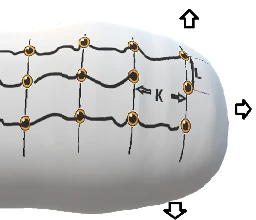
In this case,we are interested in making small pieces of rockso that they can be handled manually or with small machines.
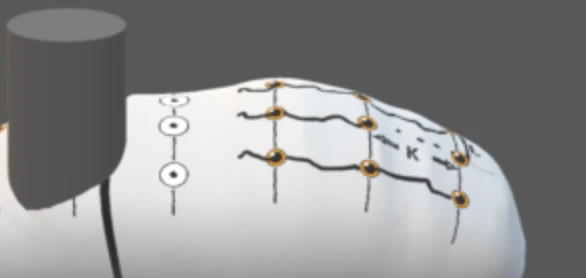
In this case, a square mesh is made.With a spacing between holesof 8 to 10 times the drilling diameter.
The approximate consumptionof this method is between10 Kg/m3-25Kg/m3
(depending on the hardness of the rock).
OPTION B – EXCAVATION
In this case,the aim is to break the maximum volume of stone with the minimum possible consumption..
In this case, wewant to make the stones as large as possible.and whenever they can be loaded by a machine.Parallel lines will be drilled to the free face.. With a distance between holes within the same drilling line.between 5 to 8 times the diameter of the drill.and aspacing between lines of 15 to 40 timesthe diameter of the drill.
The approximate consumptionof this method is between1 Kg/m3-10 Kg/m3
(depending on the hardness of the rock).
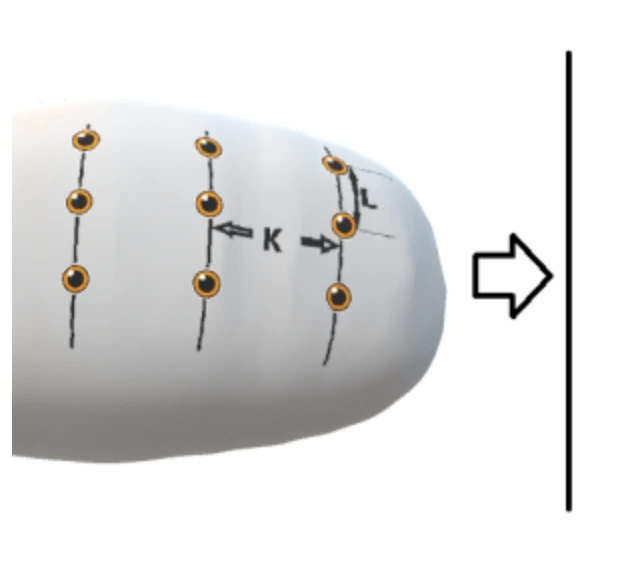
In option A,the distance la distancia Kmust be similar to the distanceL.
 In option B,the distance ofKcan be 2 to 80 times greater than the distance of puede ser 2 a 80 veces mayor que la distancia de L.(According to the hardness of the stone).
AND WHAT IF THERE IS NO FREE FACE?
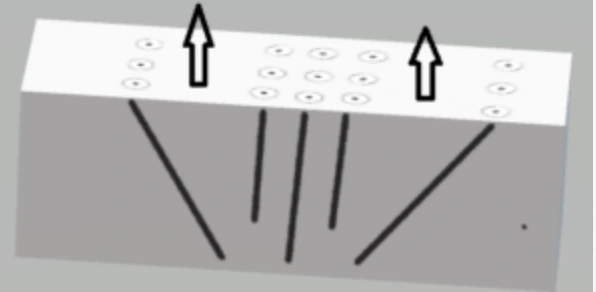
If there is no free face, it must be created.This is achieved by tilting the boreholes at angles between 60º to 45º. This ensures that the pressure of theexpansive cement ROARis directed upwards. In this case, the spacing between the holes should be reduced by 30% to 50% in a normal drilling, increasing the consumption of this method to between 15 to 35 Kg/m3.Whenever possible, small excavations will be made to create a small free face and thus continue with the ordinary method.
It is alsorecommended to make vertical holes in the centre of the V.(Cuele) to assist with expansion. These may not be loaded or partially loaded
GUIDE TABLE FOR DRILLING
| Element to break | Depth of the hole | Distance between holes | Linear distance between holes | Diameter of the hole | Kg / m3 |
| Soft rock | 100% | 40-100 | 60-90 | 30-40 | 5-10 |
| Medium rock | 105% | 30-40 | 60-90 | 38-42 | 12-22 |
| Hard rock | 105% | 25-40 | 30-80 | 38-42 | 18-25 |
| Mass concrete | 80-85% | 20-30 | 60-90 | 38-42 | 12-18 |
| Reinforced concrete | 90-95% | 15-30 | 60-90 | 38-42 | 18-25 |
HOW TO PROTECT A STRUCTURE?
In some cases, we have column footings or types of structures that we want to ensure are not damaged. For this, asafety drilling line without filling close to the structure can be made. This creates a zone of discontinuity of the stresses produced by theexpansive cement Roar(This line should not be filled) which serves as a relief.
Themaximum depthof a hole is9 metresTherecommended maximum depth of a hole is3 metres3 metrosTheminimum depthof a hole is4 times the diameter of that hole. Inreinforced concrete, drill to 90% to 95% of its depth. Incornicesorprotrusions, drill as deep as what you want to extract. Inslabs, drill from 2/3 to ¾ of the thickness of the stone. Insoft stones, such as marble, the depth of the hole is100%,inmediumor hard stone, such asgranite, the depth of the hole is105%..The best working diameter is 38 mm.
OTHER RECOMMENDATIONS
- Holes should be drilled to allow a free face for theEXPANSIVE CEMENT ROARto push. For example, drilling at a 45º angle on a flat surface will push it upwards, but drilling straight down may not allow any pressure release. To break a block without pushing out the surrounding walls, drill a cone-shaped design in the centre and fill these holes first. The cone will burst upwards and create a free face.
- The design of the hole depends on the tensile strength of what is being broken, and the size of the pieces you want when it is being done. This can often be determined experimentally.
- The design of the hole also depends on how quickly the results are needed. More holes at shorter distances will yield a quicker breakage result and more small pieces, but this requires much more work and more.EXPANSIVE CEMENT ROAR.
- Slabs are much easier to break than reinforced concrete or projections, and the drills can be spaced further apart, especially if the speed of breakage is not essential.
CONSUMPTION CALCULATION
To calculate the amount ofexpansive cement ROARthat will be used. You need to know thenumber of drills, thedepth of the drills. With this data, calculate the linear metres you are going to perform and according to the drilling diameterit can be calculated using the following formula.:

- These aretheoretical data of consumption in Kg per linear metrebut it should be taken into account that there are factors that can influence the actual consumption of theexpansive cement ROAR. Such as thewear of the materialsfordrilling, thecracksandjointsin the ground, theambient temperatureand above all theaccuracy of the mix.with waterof ROAR expansive cement.
| Diameter mm | V (dm3) | Density Kg/dm3 | Consumption KG (in one linear metre) |
28 | 0.62 | 2 | 1.23 |
30 | 071 | 2 | 1.41 |
32 | 0.80 | 2 | 1.61 |
34 | 0.91 | 2 | 1.62 |
36 | 1.02 | 2 | 2.04 |
38 | 1.13 | 2 | 2.27 |
40 | 1.26 | 2 | 2.51 |
42 | 1.39 | 2 | 2.77 |
45 | 1.59 | 2 | 3:18 |
50 | 1.96 | 2 | 3.93 |
Why choose expansive cement for your drilling?
If you need to fracture or cut rock, concrete or masonrywithout vibrations, without noise and without risk of impact, expansive cement is your ideal solution.
Key advantages:
✅ Silent and vibration-free– Perfect for urban environments, indoors or near sensitive structures.
✅ Maximum safety– Eliminates risks from explosives or flying fragments.
✅ Total control– The breakage is slow and progressive, allowing for precise results.
✅ Easy to use– Does not require special permits or expensive equipment.
Ideal for:
• Controlled demolitions in rock or concrete.
• Excavations in quarries or mining.
• Civil engineering and construction projects.
• Works where explosives cannot be used.